
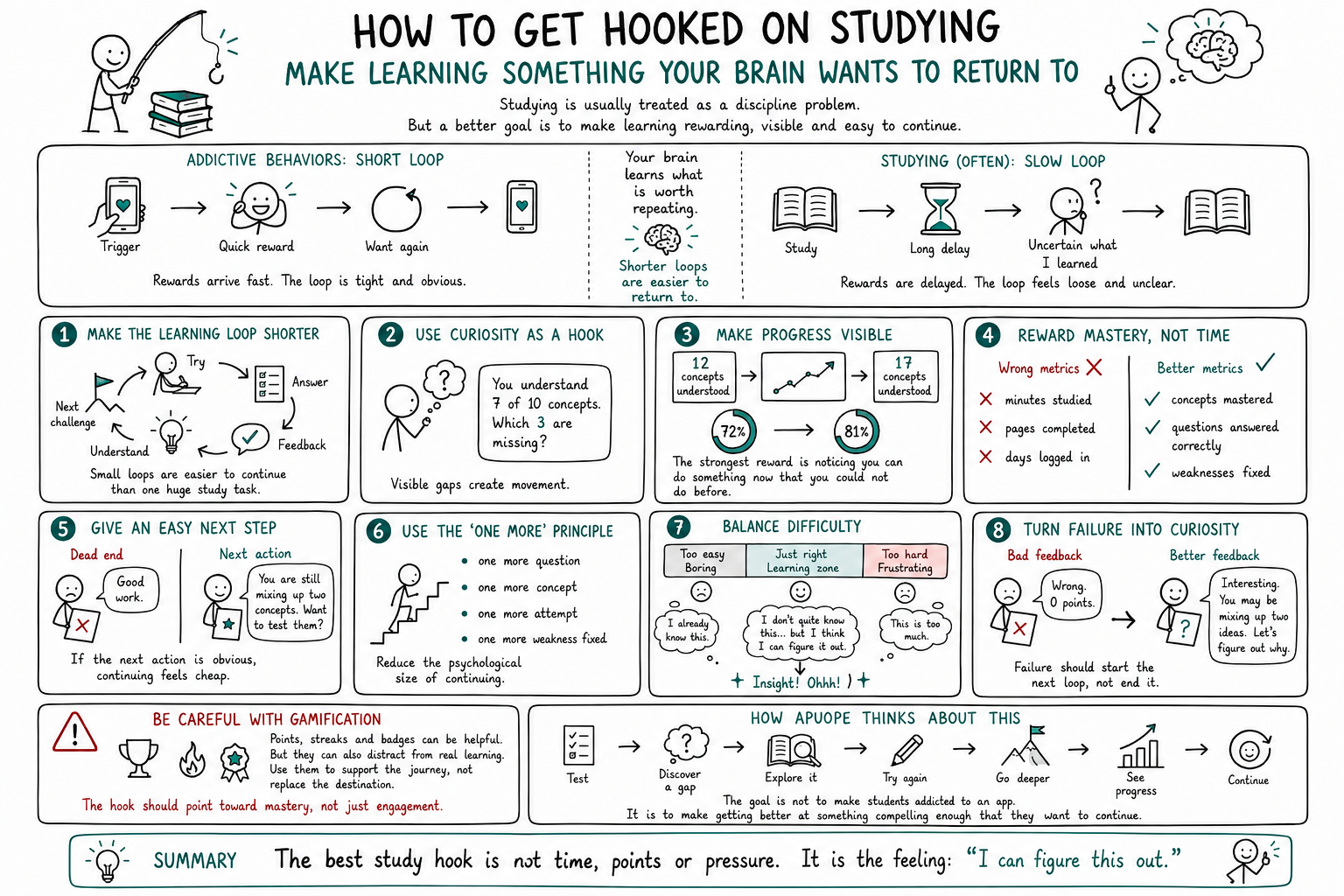
Studying is usually treated as something that requires discipline. But what if the better goal is to make learning something your brain actually wants to return to?
Think about the things people get hooked on.
Games. Social media. YouTube. Checking messages. Following sports. Solving puzzles.
Nobody needs to create a detailed motivational plan before opening Instagram.
You just open it.
And once you do, one thing leads to another.
Studying often works in exactly the opposite way.
You need to decide to study. Find the material. Figure out where you left off. Decide what to do. Concentrate. Struggle through uncertainty. Wait a long time before feeling any sense of progress.
Then we wonder why people procrastinate.
Maybe the problem isn't simply motivation.
Maybe studying is badly designed as a behavior.
Your Brain Learns What Is Worth Repeating
Habits don't appear because we intellectually decide that something is important.
They develop because our brains learn associations.
A cue appears.
We perform a behavior.
Something happens afterward.
If the outcome is rewarding—or even just interesting enough—the brain becomes slightly more likely to repeat the behavior when the cue appears again.
This is why tiny interactions can become surprisingly powerful habits.
Open an app.
See something interesting.
Swipe.
See something else.
Swipe again.
The loop can happen dozens of times in a few minutes.
Studying often has a much slower loop.
Open a textbook.
Read twelve pages.
Try to understand them.
Maybe answer some questions.
Perhaps discover tomorrow whether you understood anything.
That is a terrible feedback loop.
Make the Learning Loop Shorter
If we want people to return to studying voluntarily, we should shorten the distance between action and feedback.
Instead of:
Study for 60 minutes → eventually discover whether you learned something.
We can create:
Try → answer → feedback → understand → next challenge.
Then repeat.
A learner answers a question.
Immediately sees whether the reasoning was correct.
Discovers something they misunderstood.
Fixes it.
Gets another question.
Suddenly studying isn't one enormous task.
It is a sequence of small loops.
And small loops are much easier to continue.
Curiosity Is One of the Strongest Hooks
There is another powerful mechanism.
Not knowing.
Imagine seeing this:
You understand 7 of the 10 concepts needed for tomorrow's exam.
Immediately, a question appears:
Which three don't I understand?
That uncertainty creates curiosity.
And curiosity creates movement.
Compare that with:
Study chapter 4.
There is no mystery.
No visible gap.
No obvious finish line.
Just work.
Good learning systems should constantly reveal small gaps between what the learner knows and what they could know next.
Not to make learners feel inadequate.
To give them something concrete to close.
Progress Needs to Be Visible
Studying has another fundamental problem:
learning is mostly invisible.
You can spend an hour studying and physically have almost nothing to show for it.
That makes progress difficult to feel.
So make it visible.
Yesterday:
12 concepts understood.
Today:
17 concepts understood.
Or:
Algebra foundations: 72% → 81%.
Or simply:
You couldn't explain this yesterday. Now you can.
That last one may be the most important.
Because the reward shouldn't ultimately be points, badges or animations.
The strongest reward is:
I can do something now that I couldn't do before.
That feeling can become addictive in the best possible sense.
Don't Reward Time. Reward Mastery.
Many learning systems reward the wrong thing.
Minutes studied.
Pages completed.
Lessons watched.
Days logged in.
Those metrics can help build routines, but they are not learning.
Someone can stare at a textbook for an hour and learn almost nothing.
Someone else can struggle with one difficult concept for twenty minutes and make an important breakthrough.
The system should therefore reinforce progress in understanding.
Not:
You studied for 30 minutes!
But:
You just mastered something you couldn't do 30 minutes ago.
That creates a completely different relationship with studying.
The learner isn't accumulating time.
They're accumulating capability.
Give the Learner an Easy Next Step
One reason people stop studying is surprisingly simple.
They don't know what to do next.
Imagine finishing a learning session and seeing:
Good work.
That's pleasant.
But behaviorally, it's a dead end.
Now compare it with:
You understand the basics. But there are two concepts you're still mixing up. Want to test them?
Now there is unfinished business.
The next action is obvious.
This matters because every decision creates friction.
What should I study?
Where should I start?
What should I practice?
What am I bad at?
What should I do after this?
A good learning system should answer most of these questions automatically.
The learner should mostly have to answer one:
Do I want to try the next thing?
And ideally, the answer often feels like:
Yeah. One more.
"One More" Is a Powerful Learning Design Principle
Games understand this extremely well.
One more level.
One more match.
One more attempt.
One more turn.
Studying could use the same behavioral principle without turning education into a casino.
One more question.
One more concept.
One more attempt.
One more weakness fixed.
The goal isn't to manipulate learners into spending endless hours on a platform.
It is to reduce the psychological size of continuing.
"Study chemistry for another hour" sounds expensive.
"Try one more question" sounds cheap.
And sometimes that one question becomes five.
Difficulty Has to Be Carefully Balanced
If everything is easy, learning becomes boring.
If everything is impossibly difficult, learning becomes frustrating.
The interesting zone lies somewhere between them.
The learner should regularly encounter:
I don't quite know this... but I think I can figure it out.
Then comes the attempt.
Then feedback.
Then understanding.
Then the little moment:
Ohhh.
That moment matters.
It is one of the natural rewards of learning.
A good learning system should create as many meaningful ohhh moments as possible.
Failure Should Create Curiosity, Not Punishment
Traditional education can accidentally make mistakes expensive.
Wrong answers become red marks.
Low scores become grades.
Failure can happen publicly.
Eventually the learner may start protecting themselves by avoiding situations where failure is possible.
But mistakes are extremely useful information.
A wrong answer tells us where learning should happen next.
So instead of:
Wrong. 0 points.
The system could effectively say:
Interesting. Your answer suggests you're mixing up these two ideas. Let's figure out why.
Now failure isn't the end of the loop.
It starts the next one.
That changes everything.
Be Careful With Gamification
There is an obvious temptation here.
Points.
Streaks.
Badges.
Leaderboards.
Confetti.
These mechanisms can increase engagement.
But they can also create a strange situation where someone becomes highly engaged with a learning platform without becoming highly engaged with learning.
The learner starts protecting the streak instead of pursuing understanding.
Collecting XP instead of building capability.
Completing exercises instead of exploring ideas.
That's why the hook should ultimately point toward mastery.
The reward should increasingly come from the learner noticing:
I'm getting better.
The Best Learning Loop May Look Like This
Cue → Small challenge → Attempt → Immediate feedback → Insight → Visible progress → Next challenge
Then again.
And again.
Until something interesting happens.
The learner originally opened the system because they had to study.
But after a while, another motivation begins to appear.
They want to see what they can master next.
That is a fundamentally different relationship with learning.
This Is Where AI Changes the Possibilities
Traditional educational material cannot constantly redesign itself around one learner.
AI can.
It can notice what the learner understands.
Detect patterns in mistakes.
Change the difficulty.
Ask a better follow-up question.
Explain the same concept differently.
Connect new knowledge to something already understood.
Identify missing foundations.
And continuously decide what the most useful next challenge might be.
That means we can move away from:
Here is the material. Study it.
Toward:
Here is the next thing worth figuring out.
The difference may sound small.
Behaviorally, it is enormous.
How APUOPE Thinks About This
This is one of the ideas behind APUOPE.
Learning shouldn't begin with blindly consuming more material.
First, we need to understand where the learner currently stands.
What do they already know?
What don't they know?
What do they think they know?
What should they learn next?
From there, studying can become a sequence of increasingly meaningful challenges.
Test.
Discover a gap.
Explore it.
Try again.
Go deeper.
See progress.
Continue.
The goal isn't to make students addicted to an app.
It's to make the experience of becoming better at something compelling enough that they want to continue.
Because perhaps the most powerful study habit isn't:
"I have to study every day."
It is:
"I want to see if I can figure this out."
And once learning starts producing that feeling consistently, studying stops being something we constantly have to push ourselves to start.
Sometimes we may have to convince ourselves to stop.